For churches
A church workspace for care, publishing, and livestream operations
Relay brings people, groups, public pages, livestreams, checklists, and follow-up work into one system your team can actually keep current.
Dogfooded proof
Livestream setup that belongs next to the rest of church life
Relay's livestream detail page was exercised locally: create a service, review encoder settings, set destinations, and run the operations checklist.
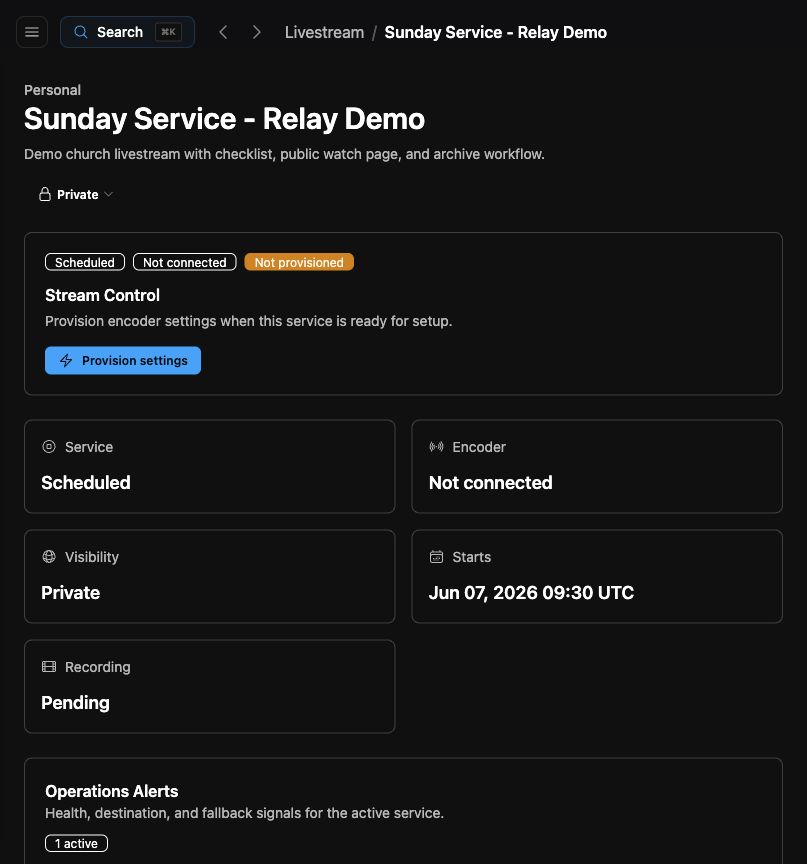
Service livestreams
Schedule streams, track readiness, manage destinations, and keep public viewing tied to the church profile.
Public organization profile
Publish directories, content, and events from the same organization that manages private work.
Operations checklists
Keep recurring Sunday work visible without splitting ministry and media into separate tools.
Use cases
Church workflows Relay can compose
Church work spans people, media, events, giving, volunteers, and public communication. Relay treats those as connected surfaces.
Groups and directories
Make member, volunteer, and ministry directories part of the same data model as care and publishing.
Public content
Publish videos, notes, livestreams, forms, and collections through your Relay organization.
Care after events
Turn attendance, forms, service notes, and livestream engagement into real follow-up.
Playbook
From Sunday to follow-up
Relay is strongest when public ministry and private care share the same memory.
Schedule
Create the livestream and review operational readiness.
Publish
Share the public service surface through the church profile.
Collect
Save forms, prayer requests, notes, and links around the service.
Follow up
Route care tasks to people and teams while context is fresh.
Capacity
Relay is built for the relationships you cannot afford to forget
Dunbar's number is useful as a starting map, but Relay uses Circles as something you can correct: closeness, urgency, and cadence stay separate.
Circles
Dunbar, made correctable
Relay treats relational capacity as a living map, not a hard ceiling. You can correct the circles, then Relay uses that context to decide who needs attention.
Closeness
Who belongs in which relational layer.
Urgency
Who needs action, prayer, help, or follow-up now.
Cadence
How often each relationship deserves a real touchpoint.
Keep church operations and care in the same room
Relay can start as a livestream and content workspace, then grow into relational intelligence for the whole church.