For campus ministries
Remember students, hosts, volunteers, and next steps across a moving semester
Relay helps missionary staff and student ministry teams turn conversations, events, host-family matching, and discipleship pathways into visible relationship work.
Dogfooded proof
Build follow-up canvases around real people and next actions
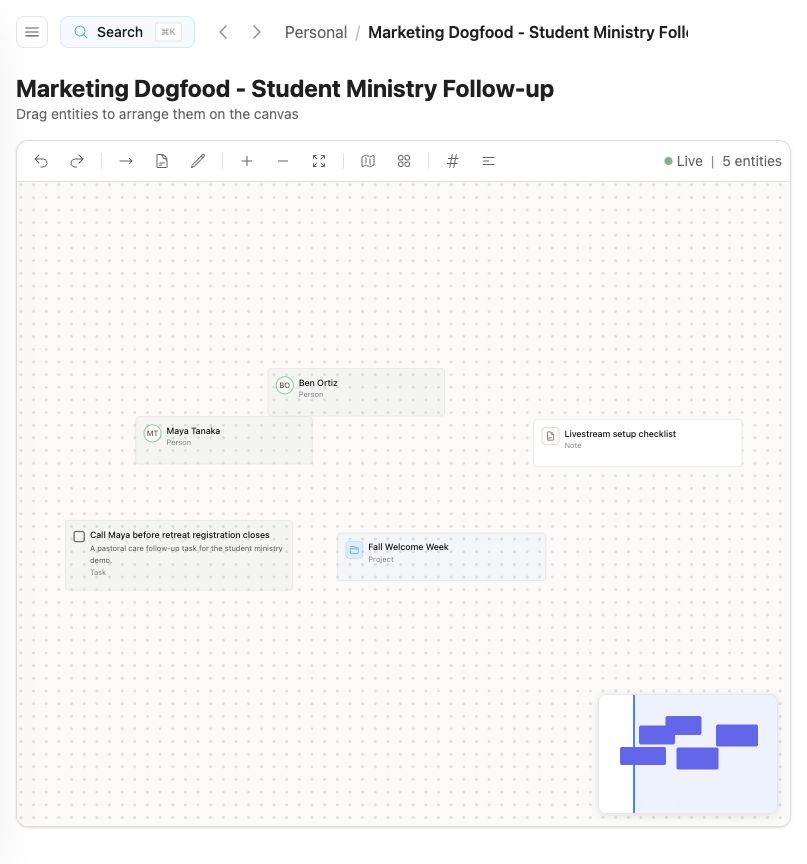
The dogfood canvas includes students, a project, and a call task. Relay's canvas bug was fixed during this pass so non-person entities render correctly too.
Student memory
Keep new people, leaders, volunteers, and hosts from disappearing after the first event.
Journey progress
Track invitations, onboarding, discipleship, leadership, and care pathways without rebuilding the app.
Matching
Use skills, availability, and context to connect students with mentors, hosts, small groups, or practical help.
Use cases
Campus ministry use cases
Semester work moves fast. Relay is designed to keep memory portable across staff, volunteers, and student leaders.
Welcome-week follow-up
Turn event conversations into people, tasks, groups, and journey stages before the semester rush scatters them.
Host-family matching
Keep preferences, availability, language, location, and pastoral context close to each match.
Student leadership
Watch students move from first contact to belonging, serving, discipling, and leading.
Playbook
A semester rhythm
Relay gives campus teams a place to keep attention from leaking between events.
Capture
Save students, notes, links, and event context immediately.
Map
Place students and tasks on canvases by group, dorm, journey, or need.
Match
Connect students with hosts, mentors, peers, and practical support.
Review
Use attention and Circles to keep warm follow-up alive.
Capacity
Relay is built for the relationships you cannot afford to forget
Dunbar's number is useful as a starting map, but Relay uses Circles as something you can correct: closeness, urgency, and cadence stay separate.
Circles
Dunbar, made correctable
Relay treats relational capacity as a living map, not a hard ceiling. You can correct the circles, then Relay uses that context to decide who needs attention.
Closeness
Who belongs in which relational layer.
Urgency
Who needs action, prayer, help, or follow-up now.
Cadence
How often each relationship deserves a real touchpoint.
Give your semester a shared memory
Relay helps campus teams remember students as people, not rows in a follow-up sheet.